- Home
- Field cases
- Field Case - Sand Injections
Sand Injections
ClampOn service department has over 30 years’ experience with sand injection jobs, for operators all over the world.
Why do sand injections?
Sand injections jobs are done as a part of commissioning of an acoustic sand monitoring system simply to ensure that the system is working properly. It can be done regularly to keep the system accurate. A good example of when we recommend sand injections is when the gas liquid ratio changes for a well, or you swap your well from high production rate to low production pressure. The frequency of sand injections varies between installations.
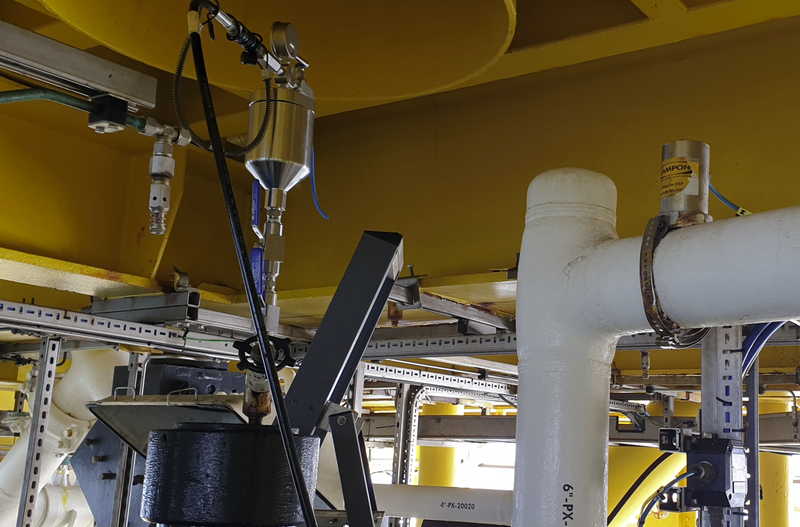
Sand injections are done using ClampOn sand injection equipment driven by air and water. We use an air driven high pressure water pump to inject a mixture of sand and water into the well stream. The sand injector unit is installed on top of the well head or on a dedicated injection point on the flow line. The injection point needs of course, to be upstream the Particle Monitor.
When we have installed the sand injector unit to the injection point. We ensure by pressure testing, that the connections can hold higher pressure than you have in your flow line. When this is done, we are ready to start the injections.
Placement of the Particle Monitor
Normally, when we do sand injections, we also bring multiple temporary Particle Monitors and install them on alternative bends on the flow line. An important part of the job can therefore be to check if you have other bends on your flowline, which gives better response from sand than the bend you have the permanently installed Particle Monitor on. This is not always necessary; it depends on whether it is the first time you are doing sand injections or not, or if your wells have changed flow regime since last time etc.
The sand injections are done by injecting a known amount of sand, for example, 200 grams into your well stream upstream of where the Particle Monitor is installed. The sand we inject will have similar particle size distribution, as the sand you are expecting to produce, or that has been produced on the platform in the past. ClampOn has different sand types with different particle size distribution profiles to choose between. Part of planning for the job is claryfing what particle size to use. Some operators want to inject fine sand with small particle sizes which can pass the installed sand screen, this to ensure that the Particle Monitor can detect fines. In addition sand with larger particle size, which is expected in case of screen failure are injected, this is to see how high the signal will be in case a screen failure happens. When we are injecting the sand, and the sand passes the Particle Monitor, we expect to see an increase in raw value. The higher velocity in the flow line, the higher is the increase of raw value.
How long does it take to do a sand injection?
Normally it takes 10-15 minutes to inject 200 grams of sand. We repeat this operation two or three times, to ensure that we can compare the injections and verify repeatability. If the well is operated on different velocities, we repeat sand injections at different rates to see what the response is for the injected sand, depending on the velocity. Based on these injections, we can make a unique new calibration (step) table for that sensor. The point of a sand injection job is to verify that your sensors can detect sand, and you improve the sand rate accuracy output from the system.
After 4 hours you have a calibrated sensor that can detect particles / sand with high accuracy.
Additional information about the ClampOn Particle Monitor
Field cases
-
02.07.26
False sand signal
On a subsea field with wells and templates spread over a large area, there had been no sand production for 10 years. Suddenly, wells on several different well templates began detecting low sand rates.
-
23.10.25
Subsea Non-intrusive Flow Temperature Monitoring on long subsea gas pipeline
ClampOn was tasked with developing a solution for temperature monitoring along a long subsea gas pipeline from a large offshore field
-

20.06.25
Installation of Subsea Corrosion-Erosion Monitor (CEM) offshore India
Installation and configuration from vessel to seabed
-

09.12.24
What can we do to prevent choke failure?
Helping the operator by using ClampOn Choke Condition Monitor to avoid producing with a choke at an opening that can cause high vibration or sound pressure levels