Software Calibration
Accurate measurements depend not only on hardware, but on correctly configured and calibrated software. ClampOn Software Calibration ensures that measurement algorithms, calculation parameters, and system settings are aligned with real operating conditions and application requirements.
The service restores confidence in measurement outputs by adapting software behavior to actual process conditions, noise environments, and monitoring objectives.
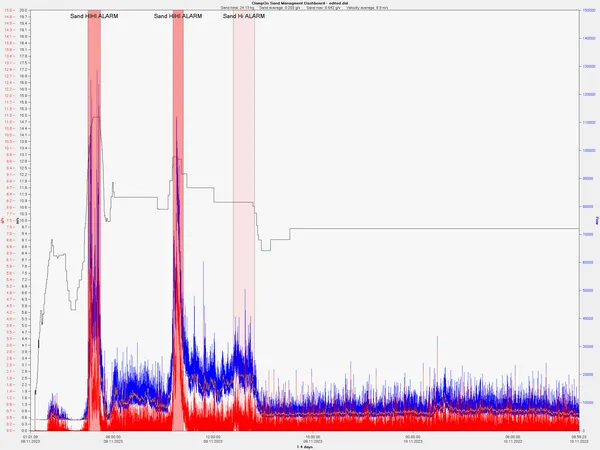
Software calibration focuses on verifying and optimizing the calculation settings used to convert sensor signals into reliable engineering values. ClampOn engineers review how raw data is processed to ensure that software behavior accurately reflects real process conditions.
Calibration activities may include:
- Verification of calculation models and underlying assumptions
- Adjustment of software parameters to match actual operating conditions
This ensures that the software layer correctly represents what the sensors are detecting.
For sand monitoring systems, software calibration is critical to distinguish real sand events from background noise and to ensure meaningful quantification.
This includes:
- Configuration of “zero” settings to manage background noise and establish a stable baseline
- Optimization of sand quantification settings to reflect actual flow conditions, noise levels, and production behavior
- Review of detection sensitivity to ensure reliable sand detection without over‑calculation
Correctly calibrated sand monitoring software delivers accurate sand rates, meaningful cumulative values, and trustworthy decision support.
For sand monitoring applications, software calibration is not a one‑time activity. As wells mature and operating conditions change, flow regimes, velocity, noise levels, GOR, and water cut can all evolve, potentially rendering previous calibration settings inaccurate over time.
To maintain reliable sand detection and quantification:
- Calibration settings should be reviewed and updated regularly
- This is particularly important following operational or production changes
- ClampOn recommends at least a yearly revision of sand monitoring settings and calibration
Regular calibration ensures continued measurement accuracy and prevents drift in sand quantification results as conditions change.
For pig detection systems / pig signaller systems, reliable triggering is essential to confirm pig passage while avoiding false alarms.
Software Calibration for PIG Detectors includes:
- Optimization of trigger settings to ensure correct alarm activation during pig passage
- Adjustment of sensitivity and timing parameters
- Reduction of false alarms caused by external noise, flow disturbances, or operational events
This ensures that pig detection alarms are reliable, unambiguous, and aligned with operational expectations.
For CEM corrosion and erosion monitoring systems, correct initial calibration is essential for long‑term wall thickness monitoring.
Software calibration includes:
- Calibration of starting conditions for the monitoring period
- Establishment of initial baseline path readings
- Verification of signal stability and repeatability
A correctly calibrated baseline ensures that future changes can be confidently interpreted as real wall thickness loss rather than signal variation.
Alarm performance is a critical part of software calibration. ClampOn engineers review and optimize alarm thresholds to ensure they are meaningful, actionable, and aligned with the operator’s alarm philosophy.
This includes:
- Review of alarm logic and limit settings
- Comparison against historical data and known events
- Adjustment of alarm behavior based on customer input and risk tolerance
Well‑calibrated alarms reduce nuisance alerts while ensuring that critical events are detected promptly.
Operating conditions evolve as wells mature and processes change. Software Calibration ensures that system settings remain aligned with current conditions throughout the system lifecycle.
The service is particularly valuable:
- After changes in flow regime, GOR, water cut, or production strategy
- Following operational modifications or well interventions
- When measurement behavior changes without any hardware modifications
This maintains measurement accuracy without requiring physical system changes.