- Home
- Sand management strategy
Building a sand management strategy
Building a sand management strategy: From sand risk to production optimization
Sand production is one of the most persistent challenges in oil and gas production. When sand enters the well stream, it can contribute to erosion of chokes, valves, pipelines, and other critical equipment. If not managed properly, sand production can reduce equipment lifetime, increase maintenance requirements, create operational challenges, and limit production performance. A successful sand management strategy is therefore essential for maintaining safe, reliable, and efficient operations.
What is a sand management strategy?
A sand management strategy is a structured approach for understanding, monitoring, and controlling sand production throughout the life of a well. Modern sand management is no longer based solely on determining whether sand is present or not. It focuses on understanding how much sand is produced, under which conditions it occurs, and how production can be maintained within acceptable operating limits.
An effective strategy balances three key objectives:
- Protecting equipment and asset integrity
- Maximizing production and well performance
- Managing sand production within acceptable limits
Many operators recognize that completely eliminating sand production is not always the most economical approach. Instead, production is often optimized by operating within established acceptable sand rates (ASR), allowing some sand production while maintaining equipment integrity and operational safety.
ClampOn's approach to sand management
When sand is produced from a reservoir, it can reduce production efficiency, increase maintenance requirements, contribute to equipment erosion, and potentially create safety challenges. For this reason, produced sand should not be ignored, and wells producing from sandstone reservoirs typically require some form of sand monitoring, preferably based on real-time measurements.
In many operations, production rates are kept well below the maximum potential rate to minimize the risk of sand production. While this approach may reduce operational risk, it can also limit production performance. ClampOn's view of sand management is that the greatest potential for safe production optimization lies between producing sand at an acceptable level and producing excessive quantities that may damage equipment or exceed operating limits.
An effective sand management strategy therefore requires a balance between production objectives, asset integrity, and reliable monitoring. ClampOn defines three key factors for effective sand management:
- Prediction
- Handling
- Measurement
Together, these elements help operators understand sand risk, prepare facilities for sand production, manage erosion and removal challenges, and verify that operating limits are not exceeded through reliable real-time monitoring.
The three pillars of sand management
ClampOn's sand management methodology, effective sand management, is built around three main elements: prediction, handling, and measurement.
- Prediction
Prediction helps operators understand the conditions that may lead to sand production. Geological and reservoir data can be used to evaluate the likelihood of sand production and support facility design, operational planning, and production strategies. Sand prediction also provides valuable input when establishing a long-term sand management plan.
- Handling
Even with good reservoir management, some wells will produce sand. A sand management strategy must therefore include methods for handling produced sand safely. This involves evaluating erosion risks, reviewing sand removal capabilities, and ensuring that facilities can continue operating when sand is present within defined limits.
- Measurement
Measurement is the foundation of any successful sand management strategy. Without reliable information about sand production, operators must rely on assumptions or conservative production limits. Real-time sand monitoring provides direct insight into actual sand behavior, enabling production decisions based on measured data rather than uncertainty.
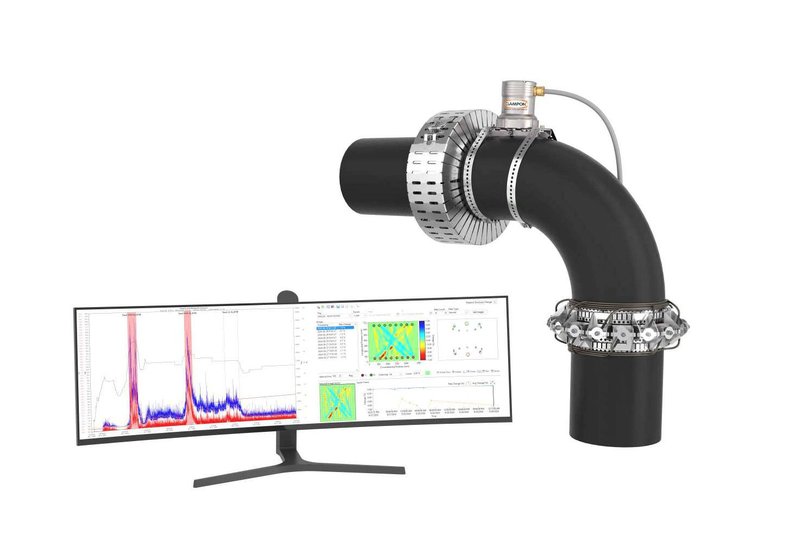
When prediction and handling measures have been established, reliable measurement is required to verify that operational limits and design criteria are not exceeded. ClampOn DSP Particle Monitor is designed to provide real-time sand monitoring, enabling operators to base decisions on measured sand behaviour rather than assumptions.
To complement sand monitoring, the ClampOn CEM (Corrosion and Erosion Monitor) provides continuous wall thickness measurements across an entire pipe bend, allowing operators to detect and track erosion development over a large area rather than at a single point. Since erosion typically occurs in regions of highest turbulence and particle impact, the preferred installation location for the ClampOn CEM is the pipe bend where the erosion potential is greatest. This provides valuable insight into actual erosion rates and supports proactive integrity management by verifying that erosion remains within acceptable limits.
Why real-time sand monitoring is essential
Continuous sand monitoring provides visibility into changing well conditions and allows operators to detect sand production before serious erosion or integrity issues develop. Real-time measurement enables operators to understand how changes in flow rate, choke settings, or reservoir conditions affect sand production.
This is particularly important because sand production is rarely constant. Sand rates may fluctuate due to changes in flow conditions, particle size, and reservoir behaviour. Monitoring systems capable of detecting these variations provide valuable information that supports informed production decisions.
A modern sand management strategy should therefore include:
- Continuous real-time sand and erosion monitoring
- Defined alarm limits
- Clear operational response procedures
- Historical trend analysis
- Integration with production data and control systems
- Preventive maintenance on the ClampOn systems, and transparent cooperation between ClampOn and operator company.
Together, these elements allow operators to respond quickly to developing sand events while maximizing production opportunities.
Operating with Acceptable Sand Rates
Many operators have moved away from the traditional “sand or no sand” strategy. Instead, they operate wells with predefined acceptable sand rates. This approach recognizes that some sand production can be tolerated while still maintaining safe operations and acceptable equipment wear.
Operating within acceptable sand rates allows production to continue at higher levels than would otherwise be possible. However, the strategy depends on accurate and reliable sand monitoring. If sand production exceeds established limits, operators can respond before erosion damage becomes significant.
As flow velocity increases, erosion potential increases. For this reason, acceptable sand rates are often linked to operating velocity ranges. A successful sand management strategy must account for both sand concentration and flow conditions when defining operating limits.
Maintaining an acceptable sand rate strategy also depends on reliable monitoring and continued system performance. Many operators choose to support their sand management programs through service agreements that help ensure the monitoring system remains up to date and continues to provide trustworthy alarms and measurements. ClampOn’s close follow-up of monitoring systems helps ensure that sand events are detected and monitored correctly when they occur.
Managing sand screen failure risk
An important component of any sand management strategy is preparedness for abnormal events such as sand screen failure. Although screens are designed to prevent formation sand from entering the production system, well conditions can change and failures can occur unexpectedly.
When a screen fails, sand production can increase rapidly, often producing larger particles and significantly higher sand volumes. Early detection becomes critical because large quantities of sand can quickly impact downstream equipment and disrupt operations. Real-time monitoring systems can identify these changes within seconds and provide immediate warning to operators.
By incorporating continuous monitoring into a sand management strategy, operators gain the ability to identify abnormal conditions early and take corrective action before significant damage occurs.
The role of non-intrusive sand monitoring
Non-intrusive sand monitoring technologies have become widely adopted because they can be installed externally on the pipe without interrupting production flow. Since the sensors are not exposed directly to the process, they are not subject to erosion, fouling, or pressure containment concerns associated with intrusive systems.
ClampOn's non-intrusive ultrasonic sand monitoring technology is based on detecting the acoustic signals generated when particles impact the pipe wall. Advanced digital signal processing techniques are used to distinguish particle signals from background noise generated by flow turbulence and process equipment.
This enables continuous real-time monitoring without disturbing flow or requiring process penetration, making the technology suitable for topside, offshore, and subsea applications.
Building a data-driven sand management strategy
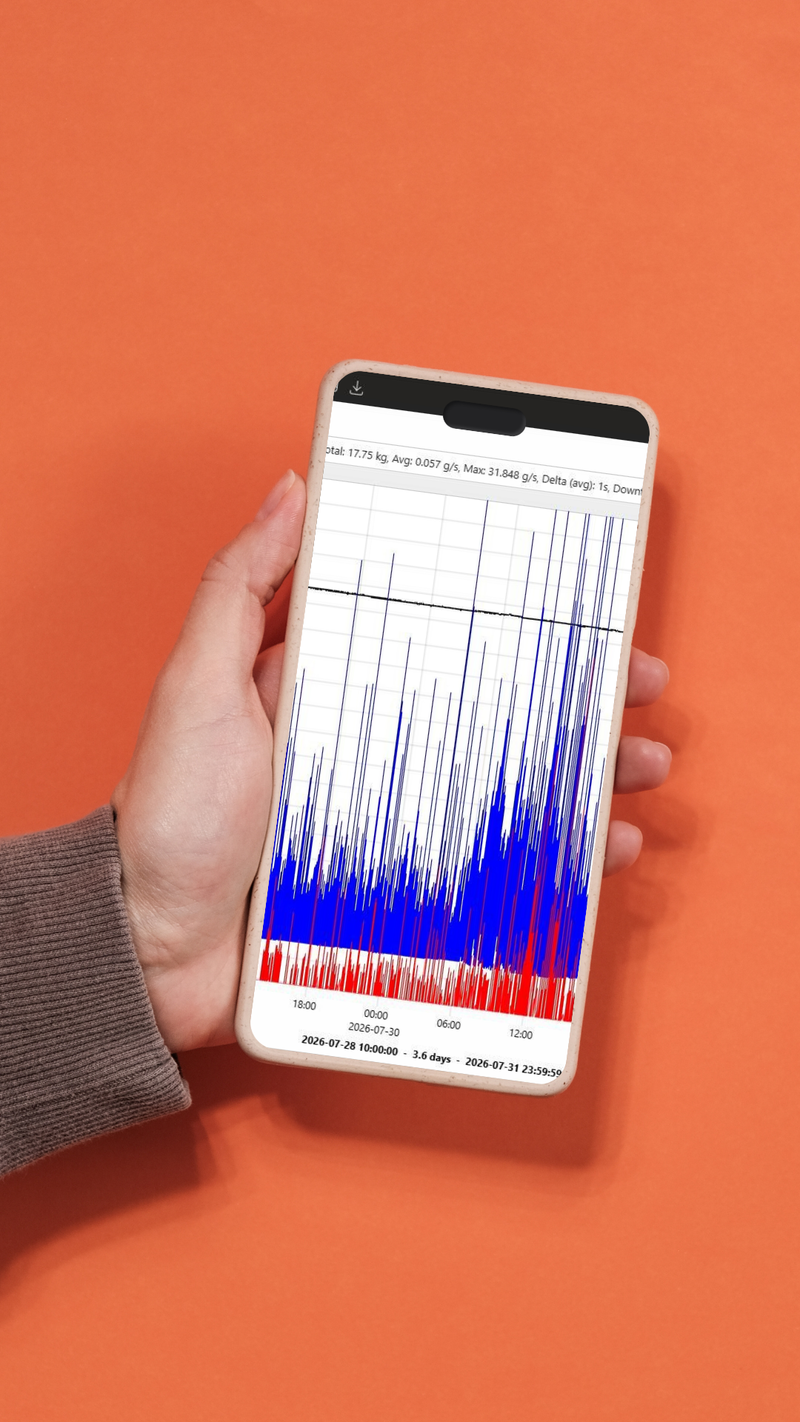
The most effective sand management strategies are built around real-time information rather than assumptions. By combining prediction, handling, and measurement with continuous monitoring and operational procedures, operators can make informed decisions that balance production performance with asset integrity.
A data-driven strategy helps operators:
- Detect sand production early
- Monitor changes over time
- Identify abnormal events
- Manage production within acceptable sand rates
- Reduce erosion risk
- Support maintenance planning
- Maximize production while protecting equipment
These capabilities transform sand monitoring from a simple alarm function into a core element of production management.
Access to monitoring data is equally important as the measurement itself. Modern sand management strategies increasingly rely on dashboards and centralized data access that allow personnel to review sand rates, alarms, and operational trends. ClampOn Cloud is available as a secure platform service that provides access to monitoring data, supporting visibility of sand production behaviour and helping operators use real-time information as part of their decision-making process.
Why experience matters in sand management
Sand management is not only about technology. It also depends on practical understanding of how sand behaves under real operating conditions. ClampOn has worked with sand production monitoring for more than three decades and has accumulated experience from thousands of wells worldwide. This experience has provided practical insight into how sand production develops, how acoustic particle monitoring data should be interpreted, and how monitoring can support production optimization and asset integrity programs.
By combining field experience, monitoring technology, and collaboration with operators and industry partners, ClampOn has helped support sand management programs across a wide range of operating environments.
Conclusion
Building a sand management strategy requires more than simply detecting whether sand is present. It requires a structured framework that combines prediction, handling, and measurement with continuous monitoring to support effective operational decision-making.
. Real-time sand monitoring enables operators to understand actual sand behaviour, establish acceptable sand rates, detect abnormal events, and optimize production within safe limits.
Combined with long-term support arrangements and digital access to monitoring data through services such as ClampOn Cloud, operators can build a more consistent and data-driven approach to sand management throughout the life of the asset.
For operators seeking to maximize production while managing sand-related risks, an effective sand management strategy should combine prediction, handling, and measurement. Reliable real-time sand monitoring provides the measurement component that enables production optimization while maintaining asset integrity and operational control.
With more than three decades of experience and data from thousands of wells worldwide, ClampOn has developed practical expertise in how sand production behaves and how it can be measured, monitored, and managed as part of a comprehensive sand management program. ClampOn's long experience in real-time, non-intrusive sand monitoring has made its technology a key component in sand management programs across oil and gas operations worldwide.