- Home
- Sand Production
Sand production
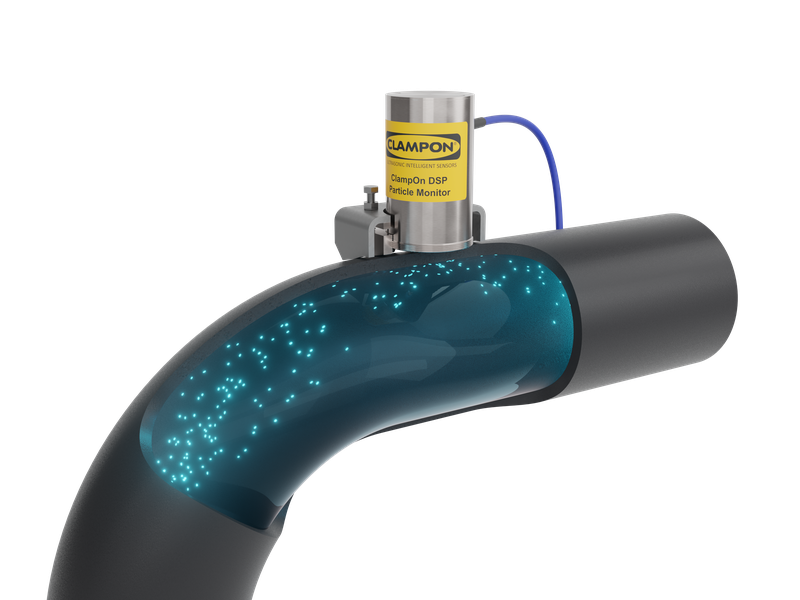
Understanding sand production is essential for safe and efficient well operation. Modern sand management is not only about detecting whether sand is present or not, but about understanding how much sand is produced, under which conditions, and how it can be controlled within acceptable limits. Acoustic monitoring technologies, such as the ClampOn DSP Particle Monitor, have become key tools in providing real-time insight into sand production, enabling operators to optimize production while minimizing risk.
What does sand production look like?
If you have the ClampOn Particle Monitor in your hand, at the office desk, or on a flow line with no flow, you will get a raw value output from the sensor, typically between two to four thousand. The value is updated every second, and we call it “idle” raw value. When you clamp the particle monitor to the flow line, downstream of a pipe bend, the sensor will detect sand if the flow velocity is high enough. The particles will hit the inner side of the pipe wall and generate a sound. This sound will be picked up by the acoustic microphone in the Particle Monitor.
Sand particles look visually like amplitudes or spikes going up from a baseline with random magnitude. The height of the amplitude is random, and the timing of when an amplitude occurs is also random. This is how a typical sand signal will look like. When the sand is produced from the reservoir, the sound of the particles is normally never constant. There will always be a raw value variation because of changes in number of particles hitting the pipe wall, also the shape and size of the particles is constantly changing.

Measuring principle of ClampOn Particle Monitor
The measuring principle of the acoustic Particle Monitor requires that the velocity of the flow is high enough for the particles to hit the inner side of the pipe wall. The particles will, due to the centrifugal force, hit the pipe wall in the bend. If that does not happen, if the velocity is too low or if the viscosity of the liquid in the flow line is too high, the measuring principle will not work; the Particle Monitor is out of its operational window. This is very important knowledge for everyone using acoustic Sand Detectors. It is also important to know that you are in the operational area for the Particle Monitor when you are producing a well. Therefore, you should be aware of what is inside your flowline, the velocity of the liquid, and how the gas behaves. If the velocity is high enough to carry sand through the pipe, most wells will also be in a range where we can detect sand.
Experience with sand monitoring
ClampOn has delivered non-intrusive ultrasonic sensors for more than 32 years. In the beginning, the DSP Particle Monitor was mainly used as an alarm system. Normally our clients operated their wells after “sand or no sand” principle. If they got sand, they choked back or closed the well and investigated more reasons for sand production. The sand management plans and strategy for different operator companies around the world have changed and developed over the years.
Acceptable Sand Rates
Many operators now choose to operate their wells with a new strategy, where some sand production can be accepted. This strategy gives higher production, less down time, and is the most cost-effective way to operate the wells. Giving us the term “acceptable sand rates” (ASR). When operating a well with this strategy, it is very important that the sand system is up to date and maintained, to measure the sand production as accurately as possible. If sand rate becomes over the ASR, the sand can cause damage to pipes, chokes and valves, etc. and become a handling issue. Therefore, many operators choose to have a support contract with ClampOn. With a support contract, ClampOn, together with the operators, can follow up on the system to ensure that if you get a sand event, it is measured / monitored correctly, and the operator gets trustworthy alarms from the sand system.
When operating with “acceptable sand rates”, we normally have an acceptable sand rate in grams/seconds defined at five different velocity ranges. For example, from zero to 5 meters per second, we have one given alarm limit, then from 5 to 10 meters per second, we have another given alarm limit, and so on. When the velocity is higher, less sand is allowed to be produced because of the erosion potential. One advantage of the acoustic Particle Monitor is that the sensitivity increases with flow velocity. At the same time, higher velocities also increase the potential for damage to the pipes if sand is present. Therefore, it is beneficial that the Sand Detectors become more sensitive as velocity increases.
Sand Management today
In modern sand management, there should be a Particle Monitor installed on each production well (for subsea also on the riser), and on the inlet of the separator. These acoustic Particle Monitors are monitoring the sand rate in real time and operating the wells by using the ASR principle. The sand rate, alarm, and other parameters are transferred to the personnel who need the data through different dashboards. The ClampOn Cloud solution is available as a service to our clients. The most important thing is, of course, that the system is up to date and can give an alarm if you get a sand rate over or above the given acceptable sand rates. When an operator receives an alarm, the required action should be clear and easy to follow. Equally important, the system should avoid false alarms to ensure reliable decision-making.