- Home
- Non-intrusive vs intrusive sa…
Non-intrusive vs intrusive sand detectors: A technical comparison
Sand production is a well known challenge in oil and gas production systems. When sand enters flowlines and process equipment, it contributes to erosion, reduces equipment lifetime, increases maintenance requirements, and raises safety risk. Effective sand monitoring is therefore essential for protecting assets, maintaining stable operations, and supporting long term production efficiency.
Introduction
Sand detection technologies are typically grouped into two main approaches: intrusive solutions that operate in direct contact with the process flow, and non-intrusive solutions that monitor sand activity externally through the pipeline wall. These approaches differ in how they are installed, how they affect operational risk, the type of data they provide, and the level of maintenance required over time. This article outlines the key technical differences to support informed and transparent selection of sand detection technology.
How intrusive sand detectors work
Intrusive Probes
Intrusive sand detection probes are installed directly into the pipeline or flowline through a hot tap or mechanical intervention. The sensing element is exposed to the process flow and detects acoustic energy generated when sand particles impact the probe surface. The signal is processed to indicate sand presence and relative sand activity.
Because the probe is located inside the pipe, it is subject to erosion, fouling, and corrosion. Installation and replacement require pipeline intervention and adherence to strict safety procedures. Measurement is limited to the local flow conditions at the probe location.
Key characteristics of intrusive probes include:
- Direct exposure to the process flow
- Installation and removal through pipeline intervention
- Sensitivity to mechanical wear and fouling
- Regular maintenance and recalibration requirements
- Point measurement at a single location
Intrusive erosion monitoring is often described using overlapping terminology. The distinction between ER probes and erosion coupons is clarified below.
ER probes and erosion coupons clarifying the terminology
In sand and erosion monitoring, the terms erosion coupon and ER probe are sometimes used interchangeably, which can lead to misunderstanding. Traditional erosion coupons are passive metal elements exposed to the process flow and assessed after a period of operation. They provide a cumulative indication of erosive conditions but do not deliver continuous measurement.
ER based erosion probes use a different principle. A sacrificial metallic element is installed in the process flow, and changes in electrical resistance are measured as material is gradually removed by erosion. This enables ongoing monitoring of metal loss over time. The element must be replaced once it has eroded beyond its measurement range.
Both methods are intrusive and require pipeline intervention. Neither provides a direct measurement of sand rate or sand concentration. ER probes are typically applied for integrity monitoring and long-term erosion assessment and reflect local erosion conditions at the installation point.
ER Based Erosion Monitoring
ER based erosion monitoring uses sacrificial metallic elements installed in direct contact with the process flow. As material is gradually removed by erosion, the electrical resistance of the element changes. This change in resistance is used to calculate metal loss over time.
The erosion element is designed to be consumed during operation. Once it reaches its measurement limit, it must be replaced to continue monitoring. ER based systems provide an indirect measure of erosive conditions rather than direct sand detection and are typically used to assess long term erosion severity.
Installation and replacement of ER elements require pipeline intervention. The measurement reflects local erosion conditions at the installation point and does not provide real time sand concentration.
Key characteristics of ER based erosion monitoring include:
- Indirect measurement of metal loss due to erosion
- Continuous or semi continuous monitoring until element replacement
- Requires intervention for installation and replacement
- No direct measurement of sand rate or concentration
- Used primarily for erosion assessment and integrity management
How non-intrusive sand detectors work
Non-intrusive clamp-on ultrasonic sensors
Non-intrusive clamp-on ultrasonic sensors are mounted externally on the pipe surface and monitor sand activity without penetrating the pipe wall. The sensor is mechanically attached to the pipe and operates continuously while the process remains in operation.
The system detects acoustic and ultrasonic energy generated by sand particles within the flowing media. Signal processing techniques are used to distinguish sand related signals from background noise generated by flow turbulence and mechanical vibration. This enables real time detection of sand activity without exposure to the process environment.
Because the sensor is installed outside the pipe, it is not subject to erosion, fouling, or corrosion. Installation and replacement can be carried out without depressurising the system or interrupting production.
Key characteristics of non-intrusive clamp on systems include:
- External installation with no pipeline penetration
- Continuous real-time sand monitoring
- No sensor degradation from process exposure
- Minimal maintenance requirements
- No risk of process fluid release
- Well suited for subsea and remote installations
Implementation considerations and technical requirements
Selection of sand detection technology depends on the operational context and monitoring objectives. Intrusive systems require acceptance of pipeline intervention and associated safety risk. Performance is influenced by local flow conditions and sensor exposure.
Non-intrusive systems operate independently of process fluid composition and do not interact with the pressure boundary. Performance is influenced by pipe material and wall thickness, but installation does not affect pipeline integrity.
In systems where intervention is difficult or undesirable, such as subsea installations, high pressure pipelines, or facilities with limited shutdown opportunities, non-intrusive monitoring offers clear advantages. Intrusive methods may still be applied where intervention capability is readily available and monitoring objectives are limited to local or long term assessment.
When to choose non-intrusive vs intrusive solutions
Choose non-intrusive clamp-on solutions when:
- Elimination of intervention related risk is a priority
- Continuous real time sand monitoring is required
- Production interruptions must be avoided
- Subsea or remote installations are involved
- Long term monitoring with low maintenance burden is desired
- Integration with control and monitoring systems is required
Consider intrusive methods when:
- Monitoring objectives do not require real time sand detection
- Periodic assessment of erosion conditions is sufficient
- Pipeline intervention capability is available
- Point measurement at a specific location is acceptable
Industry trend: migration toward non-intrusive solutions
The oil and gas industry is increasingly adopting non-intrusive monitoring technologies as part of broader efforts to improve safety, reliability, and operational efficiency.
Safety and risk reduction
Non-intrusive systems remove the need for hot tapping and reduce exposure to high risk intervention activities. This supports industry and operator objectives to minimise unnecessary interaction with pressurised systems.
Operational continuity
Non-intrusive sensors can be installed without interrupting production and provide continuous monitoring throughout the asset life. This enables earlier detection of sand events and faster operational response compared to intervention based methods.
Subsea asset growth
As subsea developments expand, intervention free monitoring becomes increasingly important. Non-intrusive sensors are well suited for subsea pipelines and risers where access is limited and intervention costs are high.
Long term cost effectiveness
Non-intrusive systems have a different cost structure compared to intrusive solutions. By avoiding pipeline intervention, component replacement inside the process, and associated production interruptions, they reduce exposure to recurring operational activities. Over the asset lifecycle, this can contribute to lower overall operating expenditure and more predictable cost profiles.
Digital transformation
Non-intrusive sand detection systems integrate with digital production platforms and remote monitoring solutions. Real-time data supports operational decision making, automated alerts, and condition based maintenance strategies that are not achievable with intervention dependent monitoring methods.
Conclusion
Sand detection plays an important role in maintaining safe and efficient oil and gas production. Intrusive probes and ER based erosion monitoring have been used for many years to assess sand related erosion and integrity risk and continue to serve a purpose in specific applications. At the same time, non-intrusive clamp-on ultrasonic sand detection technology has matured and is now widely applied to provide real-time insight into sand production without requiring pipeline intervention.
The choice between intrusive and non-intrusive approaches should be based on operational objectives, risk tolerance, access and intervention capability, and overall lifecycle considerations. Intrusive methods provide localized information related to erosion exposure, while non-intrusive sand detectors support continuous monitoring and early identification of sand production events.
Industry practice increasingly favours non-intrusive solutions for new installations and upgrades, particularly in subsea, offshore, and remote environments where intervention is complex and costly. For brownfield assets, transitioning from intrusive monitoring to non-intrusive clamp-on systems can reduce exposure to intervention related risk, enable continuous monitoring, and lower maintenance burden without changes to existing piping or infrastructure.
As operators face growing pressure to improve safety performance, limit environmental risk, maximise production uptime, and manage operating expenditure, non-intrusive sand detection has become an established and robust approach to sand management. The shift from intrusive to non-intrusive monitoring reflects a broader focus on intervention free operations, operational resilience, and data driven decision making across the asset lifecycle.
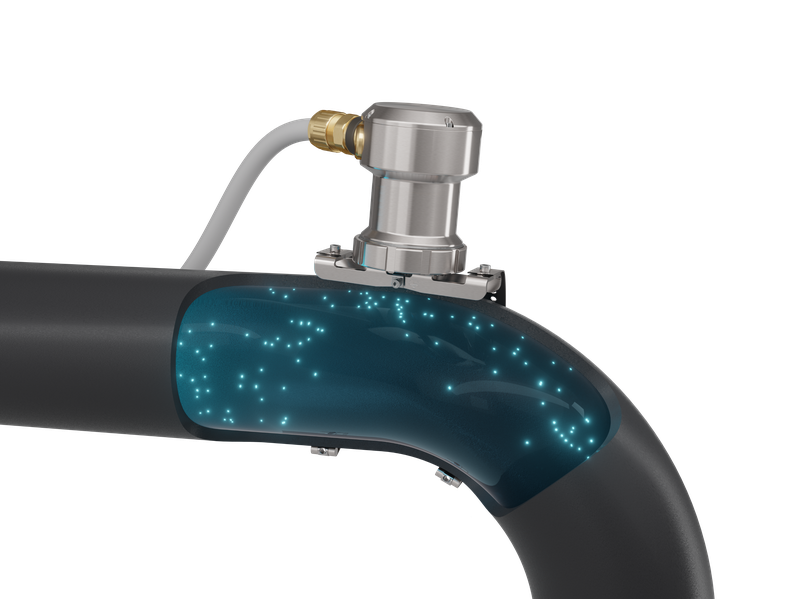
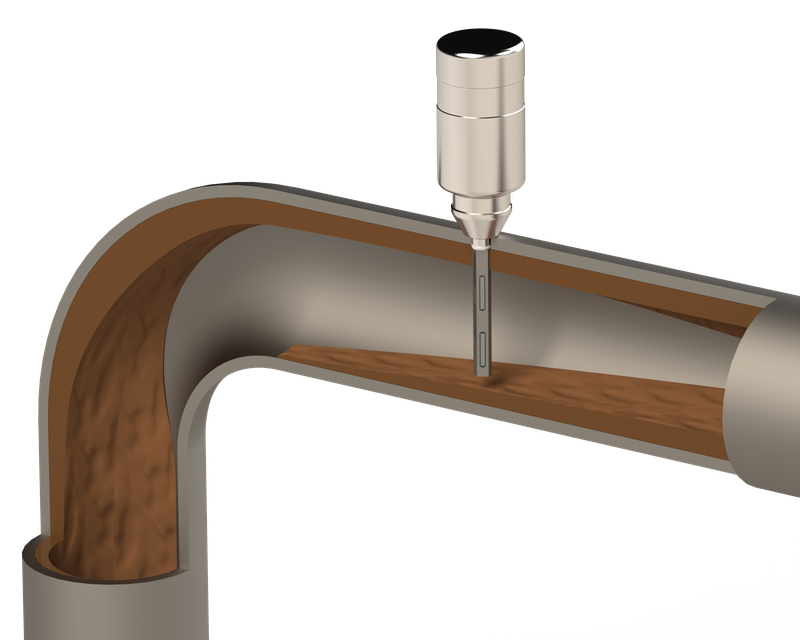
Illustration of non-intrusive and intrusive detector