- Home
- How to detect a pig in a pipe…
How to detect a pig in a pipeline: technologies explained
You have probably heard terms such as pipeline pig tracking, pig signaling, and intelligent pig tracking. While these terms are often used interchangeably, different pig detection technologies operate in different ways. Understanding how they work is the first step in selecting the right pig detection system for your application.
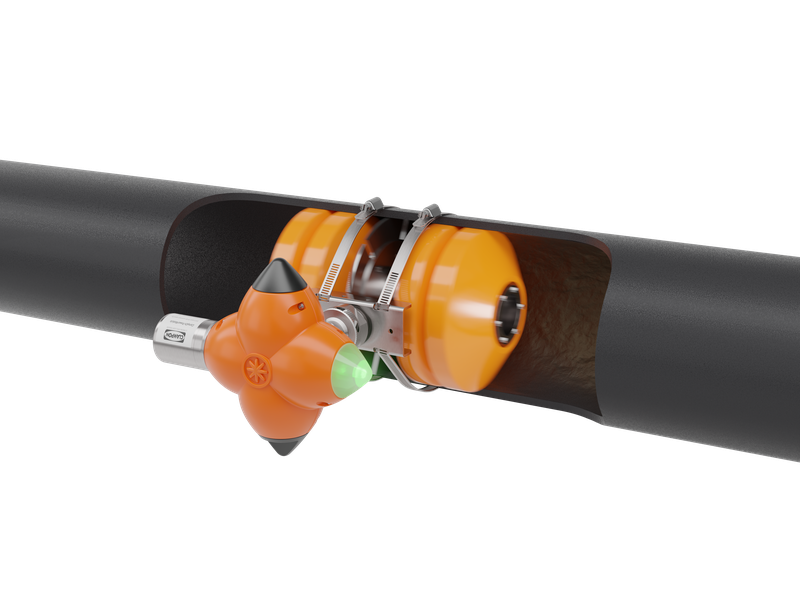
How to detect a pig in a pipeline
Detecting a pig in a pipeline is essential for safe and efficient operations. Whether used for cleaning, inspection (ILI) or batching, operators need to know exactly when a pig passes key locations.
Pig detection is used across onshore facilities, offshore installations and subsea pipelines, each with different requirements. As pipeline systems become more complex, non-intrusive technologies are increasingly used to improve reliability while preserving pipeline integrity.
Why pig detection is important
Reliable pig detection and pig tracking supports both operational efficiency and safety.
ClampOn PIG Detection enables:
- Safe pig launch and arrival confirmation
- Verified pig passage at critical points
- Reduced risk of lost or stalled pigs
- Better coordination between operations and field teams
Without reliable detection, operators may face:
- Missed pig arrivals
- Production delays and downtime
- Increased operational risk
Across both onshore and offshore environments, consistent detection is key to maintaining stable operations.
Three main technologies are used for pig detection, each suited to different conditions and constraints.
Main pig detection technologies
Magnetic pig detectors
Magnetic detection is widely used, particularly on onshore facilities.
How it works:
- A magnet is installed inside the pig
- External sensors detect changes in the magnetic field
Advantages:
- Simple and proven
- Cost-effective
- Clear pass/no-pass signal
Limitations:
- Requires pig modification
- Not suitable for all pig types, especially some ILI tools
- Less flexible where intervention is restricted
Acoustic / ultrasonic detection, non-intrusive
Acoustic and ultrasonic systems detect sound or vibration generated by the pig.
How it works:
- Sensors are mounted externally on the pipe
- Signal patterns indicate pig passage
Advantages:
- No pig modification required
- Suitable for most pig types
- Fully non-intrusive
- Applicable onshore, offshore and subsea
Limitations:
- Performance depends on installation quality and pipeline conditions
Non-intrusive clamp-on pig detection
Clamp-on detection uses externally mounted sensors and avoids any pipeline intrusion.
Key benefits:
- No penetration or modification of the pipeline
- No leak path introduced
- Installation without shutdown
- Suitable for onshore, offshore and subsea systems
- Compatible with all pig types
This approach is increasingly selected where maintaining pipeline integrity and minimizing operational impact are priorities.
Choosing the right pig detection method
The optimal method depends on several factors:
Pipeline conditions
- Gas or liquid service
- Pressure, temperature and flow conditions
Facility type
- Onshore plants
- Offshore platforms
- Subsea systems
Pig type
- Cleaning pigs
- Intelligent pigs (ILI tools)
- Batching pigs
Operational constraints
- Possibility of pig modification
- Ability to access or shut down the pipeline
Risk and accessibility
- Critical vs routine operations
- Ease of installation and access
A safer alternative to intrusive pig detection
Intrusive pig detection is increasingly seen as outdated technology. It requires pipeline penetration, creates potential leak points, and often involves higher installation complexity, shutdowns, and long-term maintenance concerns. For this reason, many operators are now replacing intrusive systems with non-intrusive pig detection. Non-intrusive technology offers a safer, simpler, and more flexible solution without compromising pipeline integrity.
When non-intrusive acoustic pig detection is the best choice
Non-intrusive detection is well suited when:
- Pipeline intervention is not possible or not desirable
- Safety and integrity are key priorities
- Pig modification is not feasible
- Installation must be completed without shutdown
- The system is located onshore, offshore, subsea, or in areas with limited access
- Stable performance is required across varying conditions
In demanding oil and gas applications, non-intrusive pig detection is no longer just an alternative. It is becoming the preferred standard for operators who want safer installation, reduced risk, and long-term reliability.
ClampOn technology has advanced dual-mode detection: Acoustic and Magnetic detection methods. With the non-intrusive ClampOn DSP PIG Detector there is no need for inserts in the PIG and the system is capable of detecting all types of PIGs or plugs. ClampOn PIG detection systems perform this operation in a simple and safe way as they only detect the PIG from the outside of the pipe. The sensor is simply clamped onto the pipe, eliminating any need for welding or drilling during installation. ClampOn's PIG Detection system is unique from the competitors because of its advanced DSP (Digital signal processing) technology. The DSP features complete digitalisation, eliminating analogue filters, circuits and amplifiers. ClampOn is the only manufacturer of PIG detection systems to use DSP, which enables the sensor to operate in several frequency ranges simultaneously, eliminating the danger of the detector being triggered by noise sources other than PIGs.
Conclusion
Pig detection / pig signalling is essential for safe and efficient pipeline operations across onshore, offshore and subsea environments.
Different technologies offer different benefits:
- Magnetic systems are simple and widely used
- Acoustic systems provide flexibility without pig modification
- Non-intrusive clamp-on solutions enable reliable detection without affecting pipeline integrity
As pipeline systems evolve, detection methods are increasingly selected based on reliability, flexibility and minimal operational impact. The ClampOn DSP PIG Detector is specifically engineered to meet these demands, delivering reliable non-intrusive PIG detection without interrupting pipeline operations.