- Home
- How to choose the right sand …
How to choose the right sand monitor for your operation
A practical guide to selecting sand monitoring solutions for topside and subsea production systems.
Why choosing the right sand monitor matters
Sand production is a well known operational challenge in oil and gas production. When sand is produced together with hydrocarbons, it can contribute to erosion of valves, chokes, flowlines and other pressure retaining equipment. Over time, this may increase maintenance requirements, reduce equipment lifetime and affect production regularity.
The purpose of sand monitoring is not to eliminate sand production, but to provide operators with timely information about changes in sand behaviour. This allows production strategies to be adjusted before erosion or integrity related issues develop.
Because sand production mechanisms, flow regimes and operating philosophies vary widely between fields, there is no single sand monitoring solution that is optimal for all applications. Selecting the right technology requires an understanding of both the operating environment and how the data will be used in practice.
Key selection criteria for sand monitors
Operating environment
The physical location of the installation strongly influences which sand monitoring technologies are suitable.
Topside installations generally provide easier access for installation, inspection and maintenance. In these environments, both intrusive and non-intrusive solutions may be considered, as maintenance activities can often be planned without major operational disruption. Non-intrusive sensors have the advantage that you do not need to shut down production in order to install them.
Subsea installations impose stricter requirements on long term reliability and maintenance free operation. Access is limited, and any future intervention may involve significant cost and operational risk. For this reason, solutions that do not require pipe penetration or retrievable probes are often preferred in subsea systems.
For harsh operating conditions such as deepwater, high pressure or high temperature wells, it is essential to verify that sensors and electronics are qualified for the full operating envelope, including transient and upset conditions.
Detection capability and data quality (Detection Sensitivity and Accuracy)
Sand monitoring systems differ in the type and resolution of information they provide.
Some system set-up may indicate the presence of sand above a defined threshold, while other set-up provide a continuous signal that can be trended over time. In many applications, the primary value lies in detecting changes relative to a baseline rather than measuring an absolute sand rate.
Detection sensitivity should be selected based on the expected sand production behaviour and the operational response strategy. Very high sensitivity may lead to frequent alarms during transient conditions, while low sensitivity may delay detection of developing sand production.
Response time should be sufficient to capture changes associated with operational adjustments, such as choke changes or drawdown variations. It should be recognized that sand production typically develops over time rather than instantaneously. However, screen failures may happen immediately. It is therefore important that your monitoring system can handle all potential scenarios.
Installation and retrofit considerations (Installation requirements and retrofit capability)
Installation requirements have a direct impact on both capital expenditure and operational disruption.
Intrusive sand monitoring solutions require process penetration and are typically installed during planned shutdowns or as part of new build projects. Retrofitting such systems on producing assets may be costly or impractical, particularly offshore.
Non-intrusive clamp on systems are mounted on the outside of the pipe, and do not require any changes to the pipe itself. This makes it possible to install them on existing systems with no interruption to production.
For subsea applications, avoiding future intervention campaigns is often a key driver. Even when initial equipment costs are higher, solutions with minimal maintenance requirements can offer advantages over the full lifecycle of the field.
System integration and use of data (Data output and system integration)
The usefulness of a sand monitor depends on how effectively the data is integrated into the operational workflow.
Compatibility with existing control and monitoring systems should be verified early. Common signal interfaces and communication protocols simplify integration and reduce engineering effort.
Equally important is how the data will be interpreted and acted upon. Clear alarm handling, trend visualisation and data logging support better decision making than standalone indicators with limited context.
Maintenance requirements and lifecycle cost
Lifecycle cost should be evaluated over the expected operating period, not only at the time of purchase.
Some sand monitoring technologies require periodic inspection, cleaning or recalibration, particularly when components are exposed directly to the process. Over time, mechanical wear or fouling may affect performance.
Externally mounted systems typically have fewer components exposed to erosion, which can reduce routine maintenance requirements. However, electronics, cabling and signal quality should still be considered as part of the maintenance strategy.
For subsea systems, the potential cost of intervention often dominates the lifecycle economics. Even a single intervention may exceed the cost of the monitoring system itself, making low maintenance solutions particularly attractive.
Safety and compliance considerations (Certification and compliance requirements)
Regulatory and operator specific requirements must be clarified early when selecting a sand monitoring solution.
For offshore and hazardous area installations, appropriate ATEX or IECEx certification is typically required. The applicable zone classification, equipment group and temperature class must be verified against the installation location and operating conditions.
In most applications, sand monitoring is used as an operational monitoring tool to support production control and asset integrity management. In these cases, the system is not part of a safety function, and functional safety requirements such as SIL do not apply.
In some installations, sand monitoring signals may be used as input to an automated protective action, such as production limitation or shutdown logic. When this occurs, the signal may form part of a Safety Instrumented System.
Functional safety requirements are defined at the level of a Safety Instrumented Function. Any Safety Integrity Level requirement applies to the complete function, including sensor, logic solver and final element, not to the sand monitor alone.
Instrument suppliers typically provide reliability data and functional safety documentation to support system design and verification, rather than claiming SIL certification of the product itself.
Whether sand monitoring is considered part of a safety function or purely an operational tool must be defined by the operator’s safety philosophy and confirmed during project engineering.
Common mistakes when selecting a sand monitor
A frequent mistake is focusing on initial purchase cost while underestimating installation, maintenance and potential intervention costs.
Another common issue is selecting a solution that is difficult to retrofit, even though many sand monitoring projects are initiated after sand related challenges have already been observed.
Insufficient attention to data integration can also limit the value of the system. Sand monitoring data that is not easily accessible or actionable is unlikely to influence operational decisions.
Finally, unrealistic expectations regarding absolute measurement accuracy can lead to disappointment. In many cases, consistent trending and change detection provide sufficient decision support.
Implementation considerations (Implementation timeline and best practice)
Installation and commissioning timelines vary significantly depending on location, scope and project planning. Topside installations involving pipe modifications are typically aligned with planned shutdowns, while externally mounted systems may be installed during short offshore visits. subject to local procedures.
For subsea systems, sand monitors are commonly installed during new build or tie in activities. Retrofit installations are also available with different kind of ROV or Diver solutions and could be installed without any interuption to process flow.
After installation, establishing a baseline during stable production conditions helps operations teams interpret future changes and respond appropriately.
Conclusion
Selecting a sand monitoring solution requires balancing technical capability, installation constraints and long term operational considerations. There is no universal solution that fits all applications, but a structured evaluation helps ensure the selected technology aligns with the intended use.
For many subsea and mature field applications, non-intrusive sand monitoring offers advantages in terms of installation simplicity and reduced lifecycle risk. In topside environments, a wider range of technologies may be suitable, provided maintenance and integration requirements are properly addressed. In the end the best solution would almost always be the non-intrusive technology that does not interfere with production flow.
By focusing on operating conditions, data usability and total lifecycle impact, operators can select a sand monitoring solution that supports safe, efficient and predictable production over time.
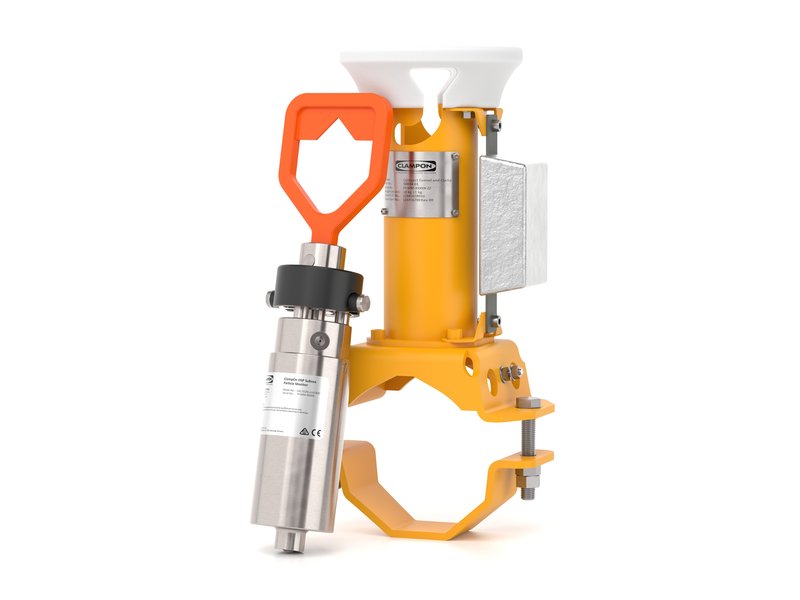
Subsea non-intrusive Particle Monitor

Topside non-intrusive Particle Monitor