- Home
- |
- Sand & Erosion Monitoring
From particle detection to metal loss
Complete protection to secure your assets
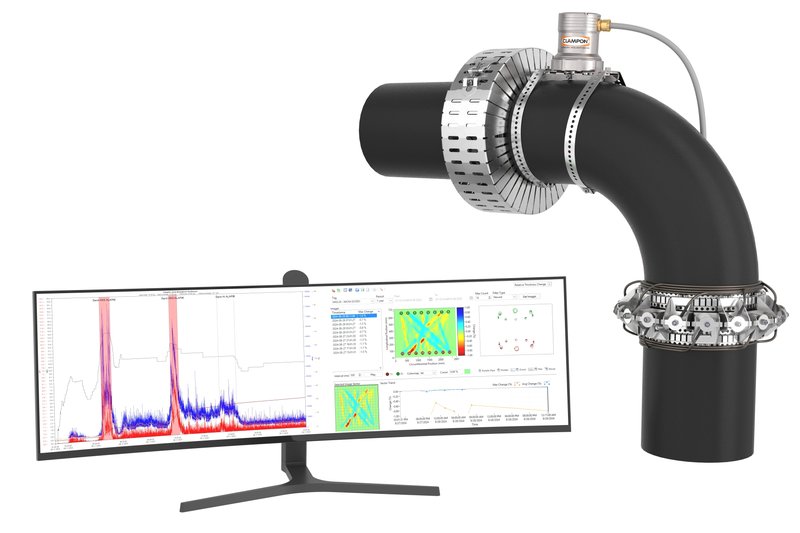
Under challenging flow conditions, erosion is rarely confined to one predictable location. Flow profiles shift, sand concentrations vary, and turbulence evolves, spreading wear across a broad area rather than a single point. This is where ClampOn’s Sand Monitor and Corrosion-Erosion Monitor (CEM) form the perfect monitoring partnership:
🔸The ClampOn Sand Monitor provides highly sensitive, real-time detection of sand production.
🔸The ClampOn CEM complements it by monitoring wall thickness across a large defined area, not just a single fixed point.
Together, they deliver complete sand-to-erosion intelligence.
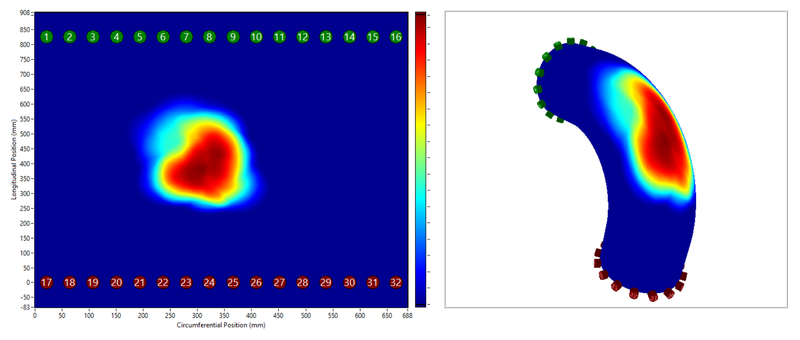
Erosion is nonuniform; shifting flow and sand distribution create wear across the entire bend.
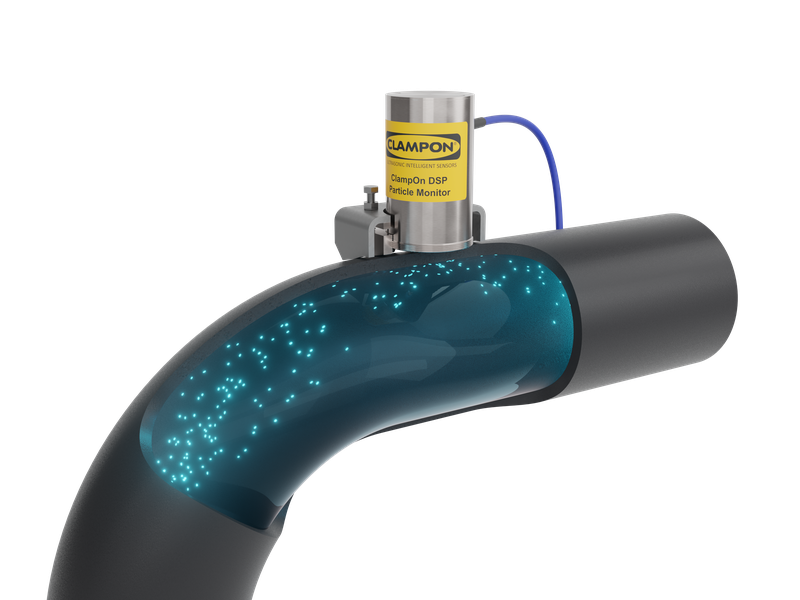
ClampOn Particle Monitor
The ClampOn Sand Monitor is designed to provide a stable and repeatable response to sand impacts. The sensor utilizes advanced Digital Signal Processing (DSP) technology, which incorporates a unique filtering technique to effectively minimize interference from other noise sources. This technology allows the sensor to discriminate between the sound generated by sand particles and background noise from liquid/gas mixtures, mechanical vibrations, and other equipment.
By processing the signal internally, the sensor enhances the signal-to-noise ratio, ensuring that the pattern of sound made by the sand is clearly illustrated in the monitoring software. This capability is crucial for accurately detecting sand production and optimizing production rates while minimizing the risk of damage to the equipment.
The most preferable installation point is typically where a vertical pipe transitions into a horizontal section. In this zone, the particles are lifted by the flow and strike the upper pipe wall with similar velocity, which gives a predictable acoustic response.
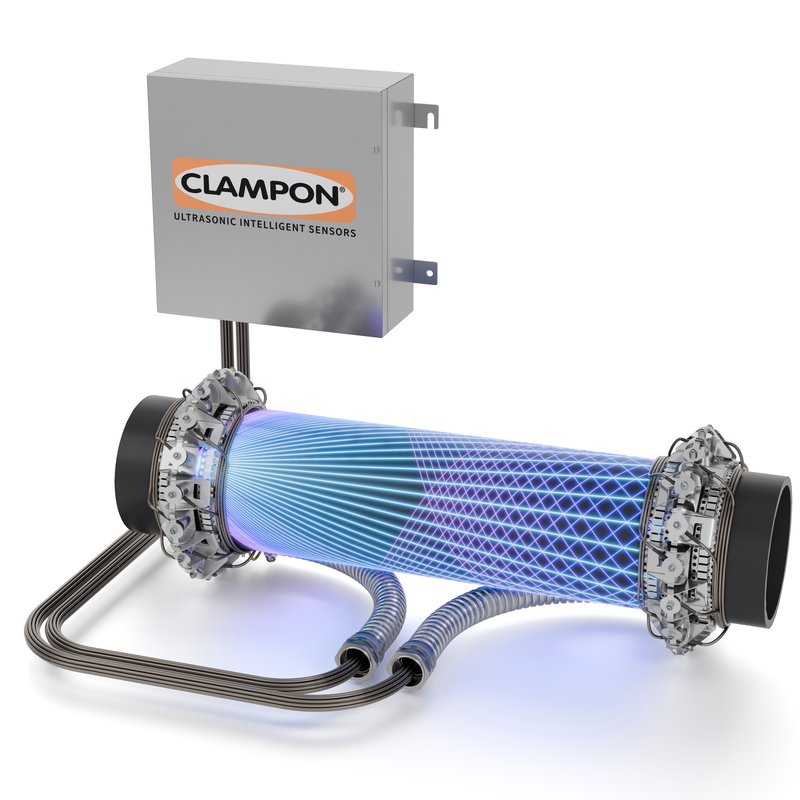
ClampOn CEM installation consisting of the externally mounted Calculation Head Unit. Clamped to the pipe, the ultrasonic transducer rings monitors the changes in metal thickness.

Tomographic representation of the pipe’s condition produced by the ClampOn CEM Software, visualizing wall‑thickness anomalies.
ClampOn Corrosion & Erosion Monitor
For long term integrity management, erosion monitoring offers an additional layer of security. The ClampOn Erosion Monitor measures both average and minimum wall thickness, allowing operators to detect changes at an early stage. It uses active ultrasound and exploits the properties of Acoustic Guided Lamb Waves to detect the changes in wall thickness relative to the reference values obtained during the installation of the system. Up to 16 transducers transmit signals to a corresponding set of 16 receiving transducers. The combined signal paths formed between them create a grid over the monitored area, enabling detection of any changes in pipe wall thickness. The coverage area and the accuracy/sensitivity depend on the number of transducers installed/pipe-size. With the right number of transducers up to 100 percent coverage of a given area can be obtained. As little as 0.1% change in wall thickness can be measured in real-time. These values can be integrated directly into the control system as simple numerical outputs, while detailed tomography data is available through the dedicated software. This gives engineers the possibility to analyze specific paths and compare results with intelligent pigging data over time.
ClampOn has supplied monitoring systems for a wide range of subsea and topside applications, including manifolds and brownfield fields that have passed their original design life. Some installations have been adapted for diver operations in shallow water, while others have been designed for ROV installation. In every case, correct installation and commissioning are essential. ClampOn recommends that its own service personnel perform the commissioning to ensure proper configuration and avoid false alarms in the control system.
Close cooperation with the operator remains the key to successful monitoring. When installation, configuration, and operational conditions are well understood, the instruments provide valuable information that supports safer operation and improved field management throughout the lifetime of the asset.
Why combining sand and erosion monitoring matters
Traditional single-point measurements risk missing the true erosion hotspot as conditions change. The ClampOn Corrosion Erosion Monitor continuously tracks wall thickness over the full critical zone, while the Sand Monitor shows when sand is present and how production conditions are changing. Together they reveal both the cause and the effect.
The result:
- Comprehensive flow assurance insight
- Early detection of hidden wear, minimizing failure risk
- Greater operational confidence and uptime
- Stronger decisions based on real conditions, not assumptions.
With both sand and erosion data working together, you gain a complete picture of how your pipe is actually behaving. That is the difference between reacting late and staying ahead of the problem.
Do not leave your asset integrity to chance.
Choose ClampOn, monitoring that sees the whole picture, every time.