- Home
- |
- Non-intrusive Flow Temperatur…
Non-intrusive Flow Temperature Monitoring
Why flow temperature measurement matters
Knowing the flow temperature in oil and gas production wells is a requirement. If process or flow temperature measurement is lost, the wells must be shut down. Flow assurance relies on process temperature measurement to control important parameters such as chemical injection rate, production rate, active heating systems and more.
Traditional flow temperature monitoring
Due to the criticality of process / flow temperature measurements, multiple temperature sensors are normally installed on X-mas trees, manifolds, process modules, and pipelines with redundancy in mind.
These are traditional intrusive type sensors, penetrating the pipe wall so that the sensing element is exposed to the process fluid or gas. They are often combined as dual purpose instruments measuring both temperature and pressure (PT sensors).
The main issue with such sensors is that they are intrusive. Intrusive sensors are typically impossible to replace subsea, especially on pipelines and modules that cannot be retrieved to the surface. Basically, the PT sensors are expected to last the entire lifetime of the field, something that can never be fully guaranteed. In addition, every penetration in the pipe represents a risk, increasing the possibility of leakage. This risk becomes greater under conditions such as very high pressure, high erosion potential, or high corrosion potential.
Intrusive PT sensors are often installed recessed or flush with the inside of the pipe. For transport pipelines, this allows pigs to pass without damaging the sensor, and on wellheads it prevents flow disturbances that could cause erosion to both the pipe and the sensor. Erosion issues are well known with traditional intrusive designs where the probe intrudes directly into the flow.
A challenge with recessed sensors is that it often leads to non-direct measurement, as the sensor itself is not in contact with the process fluid one wishes to measure. For example, in stratified flow, gas or lighter fluids will move at the top while heavier fluids settle at the bottom. This means the temperature reading depends on the position of the probe in relation to the circumference of the pipe. At the 12 o’clock position it will measure gas or light fluids temperature, and at the 6 o’clock position it will measure the heavier fluids. In practice, multiple sensors are often required to capture a complete temperature profile around the pipe circumference.
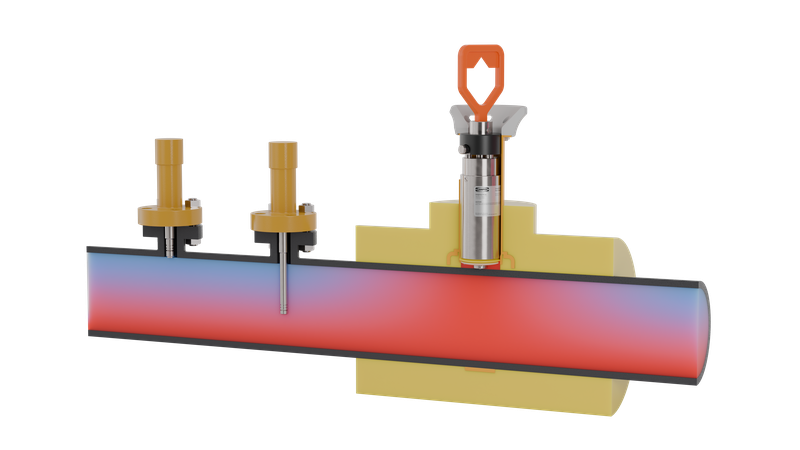
Figure 1 Recessed / flush mounted intrusive PT sensor (left), wetted intrusive PT sensor (middle) and ClampOn flow temperature sensor (right). The gradient color indicate changes to the process temperature where the pipe is insulated vs not insulated.
Non-intrusive subsea flow temperature monitoring
The ClampOn subsea flow temperature monitor provides a reliable, non intrusive alternative that calculates the internal process temperature using measurements taken from the outside of the pipe. This approach maintains full pipeline integrity.
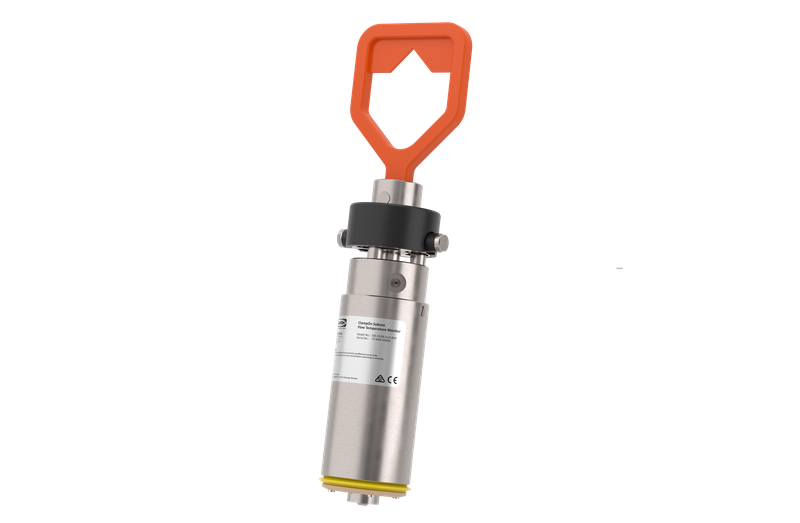
Because the temperature is measured from the outside of the pipe, it is not a direct flow measurement. Instead, the internal temperature is calculated using the measured pipe-skin temperature, ambient seawater temperature, the insulation coefficient of the pipe, and a customized thermal model developed for each installation.
As with intrusive flush mounted sensors, pipe skin temperature varies around the circumference depending on the flow regime. However, insulating the pipe significantly reduces these variations from top to bottom. The only notable drawback is an average response delay of around six minutes, caused by thermal inertia within the pipe structure. In most cases, this delay is insignificant because changes in flow temperature are generally slow. The advantages, however, are substantial:
- Non-intrusive
- Can be installed and retrieved by ROV
- High accuracy (typically ±1.5°C between +20°C and +120°C with steady flow)
- Wide temperature range (−40°C to +150°C)
- No penetration of the pipe
- No impact on flow or flow profile
- Can be combined with other applications in a single instrument, such as:
- Vibration monitoring
- Sand monitoring
- Pig detection
- Leak detection
Although most instruments are installed on the module or pipework prior to subsea deployment, they can be retrieved and replaced. This also makes retrofitting possible on older systems. In some cases where PT sensors have failed, existing ClampOn PIG detectors have been upgraded to multi purpose instruments combining pig detection, process temperature monitoring, and vibration monitoring while reusing the original fixture.
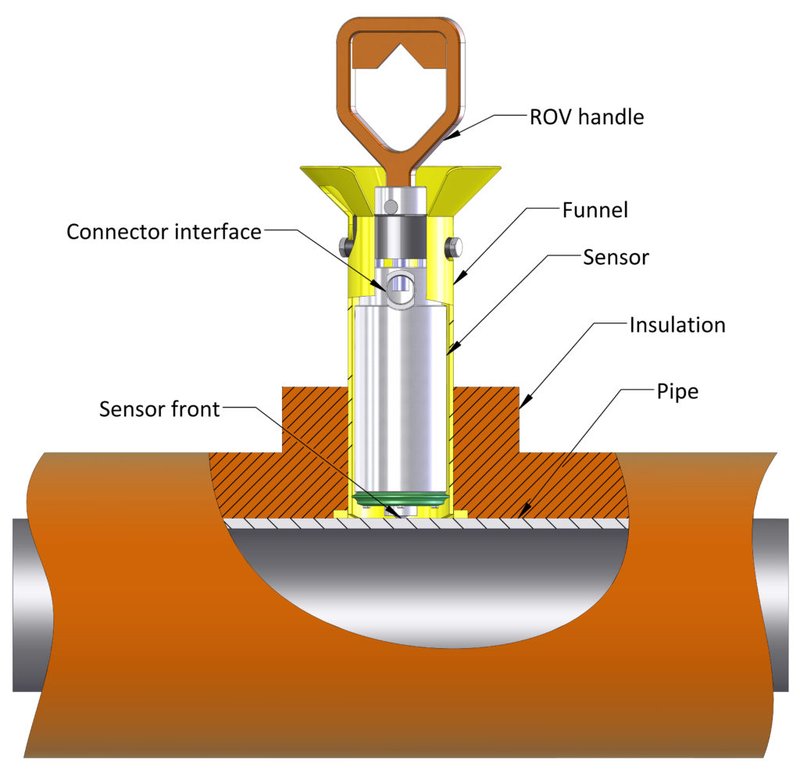
Figure 2 Cross section of a flow temperature instrument installed on an insulated flowline
Summary of ClampOn Subsea Flow Temperature Monitoring
The ClampOn Subsea Flow Temperature Monitor offers a robust and non intrusive solution for accurate process and flow temperature measurement in subsea pipelines and structures. It delivers reliability, flexibility, and cost efficiency, helping operators maintain safe and optimized production while reducing operational risk and complexity.
This article is written by Kjetil Nysæter, 23 February 2026
Kjetil Nysæter is Specialist Engineer, Business Development with ClampOn. He is involved in development and tailor made solutions of ClampOn's products, and has extensive knowledge of non-intrusive sensors.